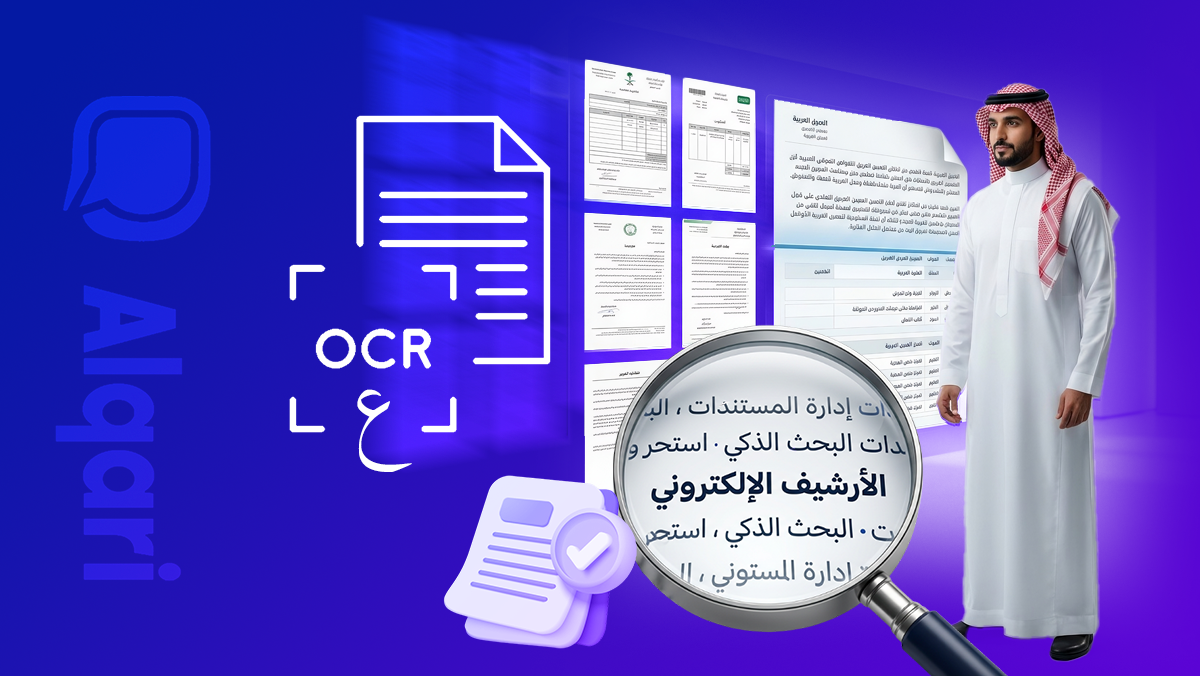
Arabic OCR: Best Tool for Extracting Arabic Text from Images and Documents with High Accuracy
Arabic OCR: Best Tool for Extracting Arabic Text from Images and Documents
Why is extracting Arabic text from images still challenging for many companies?
Imagine you have hundreds of paper contracts, thousands of invoices, or a complete archive of scanned documents, and you need to search within them or edit their content or reuse their data. On the surface, the task seems simple, but reality is completely different.
Most of these files are stored as images or non-editable PDF files, making access to information within them a slow and costly process.
This is where the importance of OCR technology appears — Optical Character Recognition — which allows converting text found within images and scanned documents into searchable and editable digital text.
But when it comes to Arabic, the task becomes more complex. Arabic has different linguistic and visual characteristics from many other languages, which causes many global tools to produce inaccurate results or require costly manual reviews and corrections.
What is OCR technology?
OCR stands for Optical Character Recognition. This technology analyzes images or scanned documents, recognizes the characters and words within them, then converts them into digital text that can be copied, edited, or searched.
In other words, instead of a document being just a static image, it becomes a usable digital document.
This technology has become essential in many sectors including:
Why is Arabic more complex for OCR systems?
Many global tools were developed primarily for Latin languages like English, French, and German. Arabic is distinguished by several characteristics that make processing more difficult:
Letter similarity — There are visually similar letters that differ only by the number or position of dots, causing frequent errors in automatic reading.
Arabic font diversity — Arabic documents may be written in Naskh, Ruq'ah, Thuluth, or other developed fonts, increasing recognition complexity.
Connected letters — Unlike Latin languages, Arabic letters connect to each other within words, making separation and recognition more complex.
Document quality — Many old or scanned documents are low quality or contain distortions that affect reading accuracy.
How do modern OCR systems work?
The text extraction process goes through several advanced technical stages:
Image analysis — The system begins by analyzing the image or document and identifying text locations within it.
Document quality improvement — Visual noise is removed and contrast and clarity are improved to increase reading accuracy.
Character recognition — The system distinguishes letters and words and converts them to digital text.
Smart review — Modern systems rely on AI to improve results and reduce linguistic and spelling errors.
Why is OCR important for Saudi companies?
In the modern business environment, data has become the primary driver of decisions. But when information is stored within images or non-searchable documents, its benefit becomes extremely limited.
OCR technologies help companies:
How do law firms benefit from Arabic OCR?
The legal sector is one of the most document-dependent sectors. Lawyers deal daily with:
Rewriting these documents manually takes a long time and increases the likelihood of errors. Using Arabic OCR technology allows extracting texts in minutes and converting them into searchable, reviewable, and editable files.
The role of OCR in serving researchers and graduate students
Many researchers spend long hours transcribing texts from scanned books and scientific references. This process consumes significant time that could have been invested in analysis and scientific research.
Through advanced OCR technologies, scanned references can be converted into digital texts ready for citation, searching, and review. This technology has become an essential tool for researchers and academics in various specializations.
Why aren't free tools always sufficient?
Many free tools are available online, but they often face clear challenges when dealing with Arabic language.
Among the most prominent challenges:
Therefore, professional organizations tend to search for more professional and reliable solutions.
How does AlQari excel in Arabic OCR?
The platform was developed to meet Saudi market needs and rely on AI technologies capable of understanding Arabic language more accurately.
The platform is distinguished by several important strengths:
High accuracy in Arabic text extraction — Systems were trained to handle multiple types of Arabic documents, improving result quality and reducing errors.
Electronic archiving support — The platform doesn't just extract texts, it also helps organize, archive, and manage documents more efficiently.
Easy-to-use interface — The platform was designed to suit various categories without need for advanced technical expertise.
Saudi market suitability — The platform focuses on real challenges facing local organizations when managing Arabic documents.
To go deeper, explore AlQari's Arabic OCR solution for printed and scanned documents, Arabic handwriting OCR for handwritten records, and document data extraction to turn recognized text into structured fields. Developers can integrate everything through the AlQari API.
What is the future of OCR technology in Saudi Arabia?
With accelerating digital transformation and increasing reliance on AI, OCR technologies are expected to play a larger role in coming years.
Multiple sectors will benefit including:
As the need for digitizing information and data management increases, this technology becomes more important and strategic.
Looking for a faster way to extract Arabic text from images and documents?
If your organization, office, or project deals with a large number of paper files or scanned documents, relying on specialized OCR tools can save you long hours of manual work.
AlQari provides an integrated environment that helps extract Arabic texts with high accuracy and convert documents into searchable and editable files for archiving, contributing to raising work efficiency and improving information management within the organization.
Start your journey toward smarter document management, and leverage AI power in transforming scattered data into organized information that supports your business growth.
Conclusion
OCR technology is no longer just a helper tool — it has become an essential part of the modern digital transformation system. With challenges specific to Arabic language, the importance of choosing the right solution capable of delivering accurate and reliable results increases.
Through combining AI and understanding Arabic language specificity, AlQari offers an advanced model that helps organizations and individuals extract texts from images and documents with high efficiency, and transform traditional documents into digital assets that support productivity and facilitate access to information at any time.